
Monday, May 28, 2012
Effective Self-Defense Education
Self-defense and prevention programs are highly diverse. A comparison of anti-rape, sexual harassment, and child safety programs suggest four key components of effective self-defense education.
1. Participants learn, observe, and practice in realistic situations.
2. Participants learn and use multiple verbal and physical strategies.
3. Participants learn skills that build on their existing strengths, abilities, and inclinations.
4. Participants develop self-esteem, self-confidence, and supportive emotional relationships.
IMPACT meets all of these criteria: participants practice in realistic situations, learn multiple verbal and physical tools, add to their existing toolbox, report increased self-esteem and confidence, and are part of a supportive and collaborative learning environment.
Adapted from: Martha E. Thompson. 1991. Self-defense against sexual coercion: Theory, research, and practice. Pp. 111-121 in Elizabeth Grauerholz and Mary A. Koralewski (Eds.) Sexual Coercion: A Sourcebook on its Nature, Causes, and Prevention.Lexington MA: Lexington Books.

Monday, May 21, 2012
From the IMPACT Chicago Archives: The Beginning
Martha
Thompson
IMPACT
Chicago Director and Instructor
2012 is IMPACT Chicago’s 25th
anniversary. In July 1987, Joe Connelly, the founder of Chicago Model Mugging
(the precursor of IMPACT) and Lonna Brooks, the first lead instructor trainee
in Chicago, formed the Self-Empowerment Group (a nonprofit) to support Model
Mugging in Chicago.
In November 1990, I interviewed Joe
Connelly about the founding period (August 1986-October 1988) of what was to
become IMPACT Chicago. I summarize the key people, main activities, major
issues, and key decisions. Below the summary are excerpts from my interview
with Joe.
Key People
Joe Connelly was the key person
during the founding of what would become IMPACT. He negotiated with leaders of
Model Mugging and he provided the funds for his and Lonna Brooks’ instructor training,
some of the funding for other instructors, and the founding of the
Self-Empowerment Group.
Other important Chicago people during this
time period were Lonna Brooks, the first lead instructor trainee in Chicago;
Dianne (Dee) Costanzo, the first certified lead instructor in Chicago; Theo
Pintzuk and Carole Isaacs, who took the first Model Mugging course (Theo later
served on the Board); Martha Thompson (who took the course in May 1988); and a Business Advisory Board (Norm Axelrod, Dennis Detzel,
Elliot Rubenstein, and Dennis Conroy).
Main Activities
Joe’s main activities during this
time were negotiating with the Personal Empowerment Center (PEC), Model Mugging
of Monterey (MMOM), and Matt Thomas (the originator of Model Mugging) to offer
courses in Chicago; to send people for training, and to recruit for classes.
The Chicago people who participated in training during the founding period were
Joe, Lonna, Dee, Carole, Martha, and Bill Stobierski. Fifty women were trained
during the founding period. The California trainers in Chicago were Judith Roth (August 1987 and May 1988), Mark Morris (August 1987), and Tom Elliot (May 1988).
Key Issues
How to create an effective,
efficient organization with a commitment to offering the program to as many
women as possible?
Are we teaching self-defense or empowerment? What is their relationship to each other?
Are we teaching self-defense or empowerment? What is their relationship to each other?
Key Decisions
·
Establish a not-for-profit not a for-profit.
·
Decline to sign a royalty agreement with Matt
Thomas (this decision was based on having no guarantee of services).
August 1986
Joe heard about Model Mugging from
friends in California and read an article about it in Black Belt Magazine.
December 1986
Joe talked with Julio Toribio and
Danielle Evans, Model Mugging of Monterey, about training to be an
instructor.
February 1987
Lonna Brooks, the first lead
instructor trainee in Chicago, took the Basics course in Monterey.
March 1987
Joe attended the first national
Model Mugging Instructor Training in Colorado.
April/May
Joe established a Business Advisory
Group. The group suggested a for-profit organization and outlined an investment
proposal. Joe decided to pursue a nonprofit group to keep the course of
the cost low and the focus on the program rather than investment returns.
June 1987
Lonna worked with a pro-bono
attorney to apply for nonprofit status. Joe and Lonna established a Board of
Directors and scheduled the first class for August.
July 1987
Lonna attended Instructor Training
in Monterey.
Joe and Lonna formed the Self
Empowerment Group (SEG)—the nonprofit organization supporting Model Mugging in
Chicago--the official beginning of what would become eventually become IMPACT
Chicago.
August 1987
The first Chicago area class was
held at (then) Hillcrest Community Center with 13 women. Judith Roth and Mark
Morris came in from California to teach with Joe as a co-teacher. Dianne (Dee)
Costanzo, who would become the first fully certified female instructor in
Chicago, was in this course.
September 1987
A second course in Chicago was
scheduled for November. A demonstration was held to recruit students. Joe
continued his training by guest instructing in Boston.
November 1987
The Board of Directors expanded
membership.
The November class was canceled
because of lack of enrollment.
January 1988
The Personal Empowerment Center
(PEC), a national nonprofit for Model Mugging, was formed. It was created by
the originators and established to protect their interests and to promote the
program. Irene Vander Zande (who would become the founder of KidPower) was the
Board President.
January/February 1988
Dianne (Dee) Costanzo and Carole
Isaacs attended Instructor Training in Monterey. Most of their fees and
expenses were paid by SEG, which had received a loan from Joe. Carole received
additional support from the then defunct group Chicago Women’s Uprising and Dee covered the remainder of her expenses.
April/May 1988
Dee, Carol, and Theo Pintzuk recruited
for the two classes scheduled for May.
The week courses were to begin,
MMOM unexpectedly asked for full payment for instructor fees. Joe borrowed
money to cover the balance. Two classes were held; one with 15 and the other
with 7. Judith Roth from California and Joe taught the larger class with Dee
co-teaching and Carole assisting. Lonna taught, with Judith’s supervision, the
smaller class. Martha Thompson and Margaret Vimont, who would later become
certified lead instructors, were each in one of the May 1988 courses.
June 1988
A fundraiser was held to raise money to send Bill to
instructor training. Carole and Joe approached Martha about working with them
to develop a curriculum for universities and colleges.
July 1988
Martha Thompson and Bill Stobierski went to Monterey for
Instructor Training. Bill’s expenses were covered by SEG and Martha covered her
own.
August 1988
Joe, Lonna, Dee, Martha, and Bill set dates for two classes
in the fall. Martha negotiated with North Park College for a location for the September and October courses and actively recruited for the
classes. Carole went on leave.
September 1988
The first class in Chicago taught totally by a Chicago team
was held at Mundelein College. Lonna was in charge of the bookkeeping and
organizational finances. Lonna and Joe taught the course with group
facilitation assistance from Dee and Martha assisted. Bill was the guest
instructor. Martha continued to recruit for the October class.
October 1988
Lonna and Joe again taught with Dee providing facilitation
support. Lynn Fernandez and Sue Albertson assisted. Lynn and Sue suggested
class assistant training be developed. Bill and Martha came in for the final
two classes (at that time the class was offered in 5 hour, 5 day sessions).
Bill was the guest suited instructor and Martha was an observer.
Acccomplishments
By the end of the Founding Period, a nonprofit organization had been established, 5 courses had been offered (August 1987, 2 in May 1988, 1 in September 1988, and 1 in October 1988) with a total of 50 graduates and Chicago had an instructor team of 2 suited instructors and 3 lead instructors in different stages of instructor training.
By the end of the Founding Period, a nonprofit organization had been established, 5 courses had been offered (August 1987, 2 in May 1988, 1 in September 1988, and 1 in October 1988) with a total of 50 graduates and Chicago had an instructor team of 2 suited instructors and 3 lead instructors in different stages of instructor training.
Sunday, May 13, 2012
Three Generations of IMPACT Graduates

Lili Betancourt, IMPACT Grad 1990
I guess every woman has worried about what she could, would do if attacked. At one time this was the scary stuff of a recurring nightmare. It was the kind of concern that lives mostly under the level of consciousness, like a sleeping monster keeping me tip-toeing through life.
Twenty-three years ago I came across a flyer for a unique self-defense course and I was intrigued by more than it’s name. Then called Model Mugging it promised empowerment. When I witnessed a graduating class of women in action, I was sold. I signed up for the next class along with my mother. There were times I worried about her living on her own and having to travel for her job. Her best friend, my sister, a cousin, friends and acquaintances have since joined the ranks of IMPACT graduates. Each of us exhilarated by the release of worrying and wondering- Will I, can I be safe?
Now I believe I really turned into a worry-wart when I became a mom. What took me by surprise was the feeling of vulnerability that accompanied the joy of my daughter’s birth. I had two small sons but this was “a man’s world”, wasn’t it? They’d never be shamed, embarrassed or angered by an assault of ugly catcalls and rude comments. How do you prepare your little girl for that?
Her dad had a few ideas but ninja warrior training wasn’t a real life option. So I drilled my little ones in setting boundaries and we practiced using our voices just as I’d learned to do in IMPACT. Years later my daughter was excited to turn 16 and get her license. I was excited for her to take IMPACT. I got to see that familiar look of exhilaration on her beaming face. Her dad likes to tease and calls us ‘triple threat’ when we walk down the street, three generations of IMPACT graduates.
Monday, May 7, 2012
Two Friends Teach IMPACT
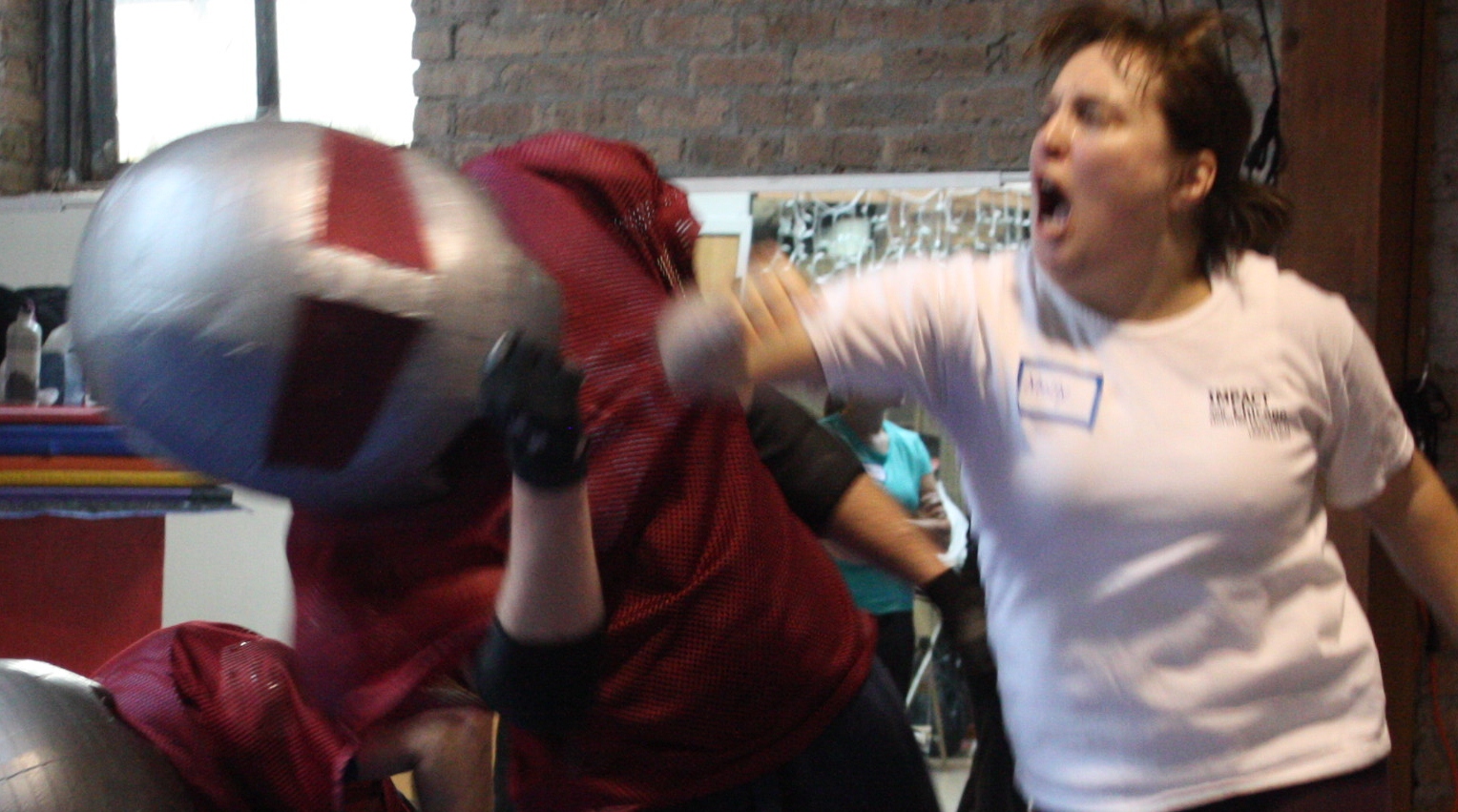
Molly and Nat are friends. Nat is a librarian who lives in Northfield, Minnesota. Molly is an acoustics consultant who lives in Chicago. Every so often Nat gets in his car and drives 7 hours to meet up with Molly. In May, Molly and Nat will meet at Dominican University Gym in River Forest. Nat will put on a suit of armor and Molly will put on a whistle and together they will teach women to be their own superheros.
Molly and Nat are instructors with IMPACT Chicago. May 18, 19, and 20 they will teach (along with Rob Babcock and Margaret Vimont) the IMPACT Chicago Core Program. The Core Program is IMPACT Chicago's most intensive program, allowing women to gain the most self-defense training in the shortest amount of time. Over the three-day program, Molly will teach women how to increase their awareness, verbal boundary setting, and physical skills.
Women will practice these skills in simulated real life scenarios where Nat, in his body armor, will take on a range of roles, including the nice guy looking for his lost dog, the co-worker who disrespects his colleague’s boundaries, and the date who decides he wants more than dinner. Molly will be right there with each woman, coaching if she gets stuck and cheering her as she defends herself.
With Nat in the armor, women will set strong verbal boundaries and practice delivering strikes and kicks with full force, just as they would need to in an actual attack. By the end of the course, women will have repeatedly practiced skills to assess danger, set boundaries, and respond effectively to verbal and physical attacks.
Jennifer who is now her own superhero says: “IMPACT allowed me to find strength, both emotionally and physically, to defend myself. I feel empowered not only in my belief that I can safely get out of potentially dangerous situations; I also feel like I have the ability to face up to all challenges I will face in my life—IMPACT helped me to learn to believe in myself.”
Molly Norris has a BA in Physics with a minor in Music from Boston University, an MA from Stanford University in Music, Science, and Technology, and an MS in Building Technology from Rensselaer Polytechnic Institute. She also studied opera in Lucca Italy and now studies and performs vocal jazz. She is an acoustics consultant at Threshold Acoustics.
Nat Wilson has an MA in History along with a Secondary Education Teachers Certificate DePaul University and an MLS from University of Illinois 2009. He works at Carleton College as the Digital Archivist and Library Technology Coordinator. Nat lives in Northfield Minnesota with his wife Martha (Molly’s best friend).
Amelia says: “I cannot say enough good things about what IMPACT has done and meant for me. IMPACT has given me the confidence to react in any situation, whether it's as little as setting a verbal boundary with someone on the train or as major as defending myself in a physically violent situation in the community or, heaven forbid, my own home. IMPACT brings out the inner super woman that you never thought you had, or were afraid to show!
Yes, women leave IMPACT knowing they are their own superheros. We just haven’t figured out yet what to call Molly and Nat—super-super heroes or just heroes?
Monday, April 30, 2012
DOING WELL BUT ROOM FOR IMPROVEMENT
Martha Thompson, IMPACT Chicago
Director and Instructor
IMPACT Chicago is committed to ending
violence and building a non-violent world in which all people can live safely
and with dignity. By teaching self-defense, we provide women and girls with the
tools they need to prevent, minimize, and stop violence. With that, IMPACT
Chicago is committed to making its programs accessible to people of all
economic, racial/ethnic, and social groups.
One thing that keeps IMPACT strong and growing, even with
limited resources, is our regularly gathering information about our programs
and then assessing how well we are meeting our mission and what we can do to
improve. An important part of this process is also letting graduates, donors,
and the public know how we stack up. In
this blog, I reflect on how well we are doing in terms of making IMPACT
accessible. Thanks to Naomi Love, IMPACT Chicago Workshop Leader and former
office staff, for compiling age and racial/ethnic demographic data for 2011
Workshops and Core Programs.
IMPACT Chicago met our
goal of making our programs accessible to people of all economic and age
groups, but did not adequately meet our goal of reaching all racial/ethnic
groups. The median income of people served in IMPACT Chicago in 2010 (latest
income data available) was similar to the median household income in Cook
County ($46, 911). The median income for IMPACT Chicago participants in the
Core Program was $40,001-$60,000 and for Core Skills participants
$20,001-$40,000. We served women and girls in a wide income range, from under
$20,000 to over $140,000. IMPACT Chicago
served a wide age range in 2011, from 11-60+. The majority of participants,
however, are 20-50.
As you can see in the
Table below, in 2011 women and girls from a spectrum of racial groups
participated in an IMPACT program, however, overall White Americans areoverrepresented.
IMPACT is proportionately serving Asian Americans and Native Americans, but
falls short in bringing IMPACT to Latinas and African American women.
IMPACT Chicago
Programs & Chicago Demographics by Race/Ethnicity, percentages
|
|||
Race[1]
|
Population
|
Workshops[2]
|
Core Program
|
White
(non-Hispanic
white)
|
45%
(31.7%)
|
65%
|
78%
|
Black or
African American
|
32.9%
|
17%
|
11%
|
Other race
|
13.4%
|
NA
|
1.5%
|
Asian
|
5.5%
|
6%
|
4
%
|
Two or more
races
|
2.7%
|
NA
|
NA
|
American Indian
|
.5%
|
NA
|
1.5%
|
Ethnicity:
Hispanic/Latino
|
28.9%
|
17%
|
4
%
|
How
can IMPACT Chicago improve?
·
Because Chicago is a highly segregated
city, IMPACT Chicago must continue its efforts to offer programs in every part
of the city.
·
IMPACT Chicago must also expand making
connections with organizations and organizational leaders in all communities.
·
IMPACT Chicago must also continue its
commitment to diversifying its volunteer and instructor groups.
Monday, April 23, 2012
Bring Your Spark to IMPACT
Ann-Christine
Racette
IMPACT
Grad and Publicity Committee Member
I used to
fancy that my silent contribution to society would be my watercolor paintings.
Since 1995, I have accumulated a huge body of work. (And yes, I also got a day
job.) Despite my friends’ prodding, I wasn’t ready to share my paintings with the
wide world. A woman who was a mentor once told me “You can’t keep your
irreverent spark all to yourself forever”.
As 2012
approached, I was ready for something brave and adventurous. I didn’t suddenly
feel more confident politically, but with experience I saw more clearly. That
was my power, I decided.
I took
inventory of my professional skills: persuasive writing, obsessive
organization. I took inventory of the abilities my friends have pointed out:
listening, empathy, impassioned speech. None of these make rocket science, but I
hoped that together they could be of some use. I didn’t expect to change the
world. But, humbled and inspired by the IMPACT instructors’ and staff’s years
of dedication and service, I wanted to lend a helping hand.
I chose
IMPACT Chicago because it coalesces my big-sisterly concern for young women; my
care for my close ones; my passion for my social beliefs; my vision of what a
better place this could be if we all used our intelligence; my outrage for the
erosion of basic rights; and my impulse to give back and pass on everything
that I have received. When I read an IMPACT e-mail newsletter calling for
volunteers, I jumped at the chance to have a hand in all this by contributing
to the marketing and publicity efforts.
I discovered
that I do have something to say. I am finding my voice—the voice I first
exercised seventeen years ago, in a Core Program. I am putting my writing in
the service of something I care about, tapping into the same compassion with
which I supported my IMPACT classmates. I am arguing clearly for what I believe
in, using the same clarity of mind I practiced in the IMPACT fights.
What is the
skill you are secretly proud of? What special ability have your friends
casually pointed out to you? Imagine what a gift it would be to your community,
and how you would blossom from sharing it!
______________________________________________________________________
Word of
mouth is the most effective tool we have because it is a message born of
experience, conveyed with firm belief, out of concern and respect for the
recipient. IMPACT--pass it on!
Monday, April 16, 2012
What Would Yoda Do?
Nat Wilson, IMPACT Chicago Suited Instructor

I remember once jokingly saying to a group of women in a Core class after a particularly emotional fight, "Yoda would really hate this stuff." We had just seen over a dozen women fight on the mat with a really impressive amount of power fueled by the emotion they were feeling in the scenario. Afterwards we sat down to talk about what they had just experienced and almost all of the students commented either on the emotions they were feeling or the intensity they saw in other women on the mat. Creating an environment where students have the license to bring whatever they feel to their fights is an essential part of the IMPACT Chicago curriculum.
While I was kidding then, it does encapsulate a counterproductive message we hear from many other sources about how to approach self-defense. In countless action movies, emotion is at best a liability. More likely it is presented as a destructive force that can consume the protagonist as well as everyone else around them. From Bruce Lee's potato chip fueled quest for vengeance in the Big Boss to Yoda's vague comments about the slippery slope of being afraid, story tellers reiterate the same message: things go a lot smoother for the main character if they chill out, stay detached and unemotional. Many other examples abound including most kung fu movies, the Hulk, Rocky III, all the Borne movies, the Transporter, Buffy the Vampire Slayer, el Mariachi and many more.
The idea that emotions are dangerous is not only present in popular culture but is also widely accepted as true by members of some self-defense and martial arts communities. Many self-defense instructors (outside of IMPACT) I know commonly claim emotions cloud your judgment or makes you irrational and therefore incapable of making good decisions. Some have even gone so far as to say that allowing someone to use emotion as fuel for a fight makes that person more violent and reckless.
IMPACT's philosophy, on the other hand, doesn't have this hang-up and I find this very refreshing. We assume that whatever it takes for someone to protect herself is a good thing, whether that means getting mad, being afraid, or just loving fighting. Some people don't need their emotions to fight well, but if you do need it, it is a tool that is available to you. That is one reason IMPACT's method is successful; people have the space and the freedom to do what they must to keep themselves safe. When fighting for your life (which with sexual assault is often the case) it doesn't really matter how you get there, just as long as you are safe in the end.
So I take issue with the idea that emotion has no place in self-defense. Despite all the warnings of popular culture and some self-defense instructors, IMPACT student don't become more violent because they feel rage or joy when defending themselves. Additionally, some of the most effective fights I have ever seen are when a woman is fighting and crying at the same time. Emotion is an asset in self-defense, not a liability. It is human, and it is good.
Subscribe to:
Comments (Atom)