Monday, June 18, 2012

Tools

Emma Goldman-Sherman

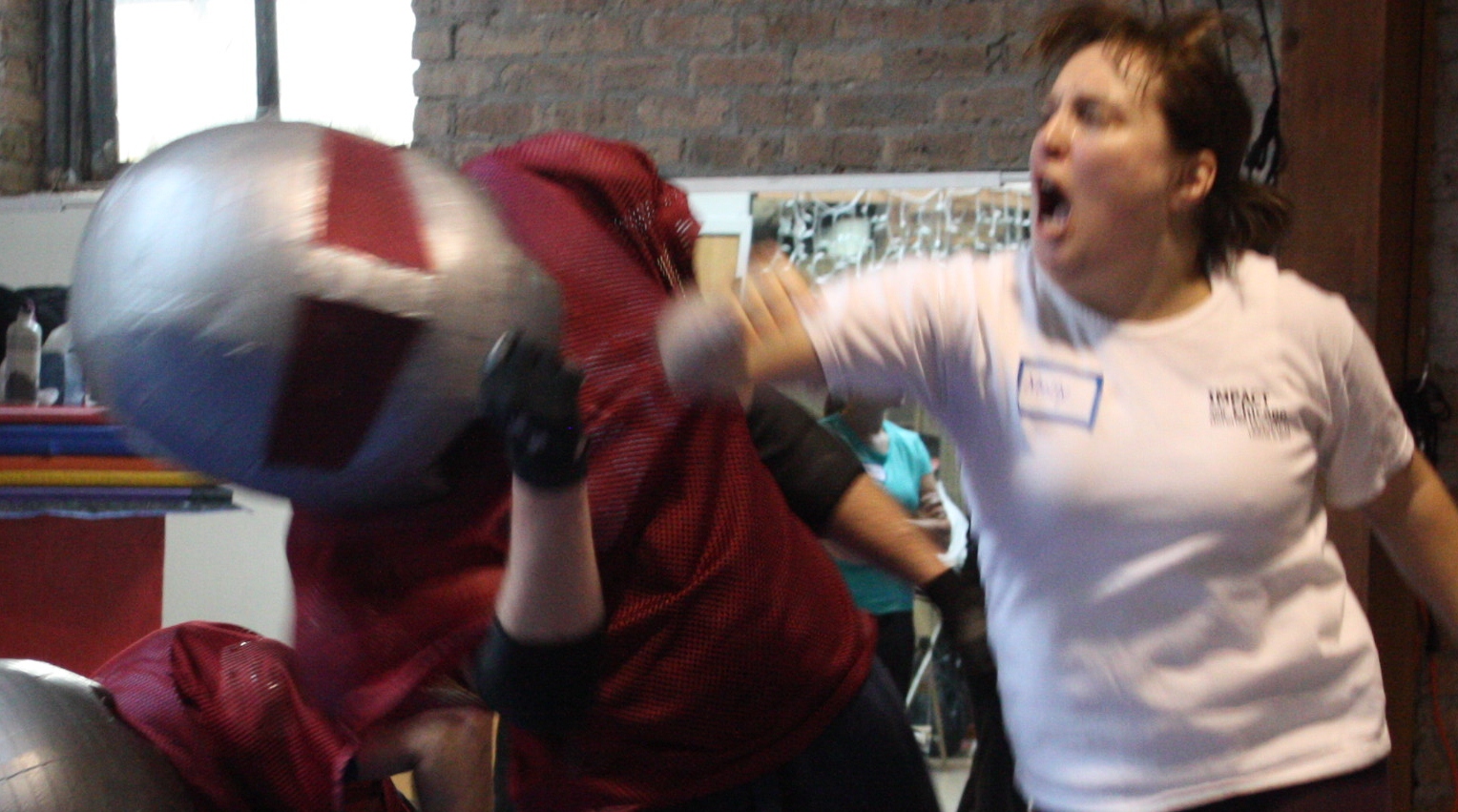
Step catch-up eye strike
Step catch-up knee to groin
Step catch-up heel of hand to jaw
Step catch-up knee to groin
we are dancing forward for a change
I can back you up to the edge of the world

when you go down I have knee to head
if you take me down I have hand slap to balls
shake and bake, elbow to face, pivot to load
I can straight kick and side kick
pull close for the ax-kick
I can switch legs and do it again

you are not padded
all my blows land in your soft flesh
you are not expecting me to fight
I can flip you out of me with a hip thrust
or a bicycle kick.  I can move through you
ghostly father of my dreams
incarnate assholes of my past

we are dancing forward 
and when we dance
I change the dream 
with the tools I've learned 
how to shout not scream
I now recognize manipulation, warning signs
I can breathe, reset, protect myself

I can say what I want
I can make myself heard
and if you can't adjust to that
then I can walk away,
or I can dance you backward 
to the edge of the world
and show you the stars. 


2012 copyright Emma Goldman-Sherman

Thanks to Emma and Prepare (IMPACT New York)

Monday, June 11, 2012

Currents in the IMPACT classroom: Where the river takes us


Margaret Vimont couples her dedication to the women going through IMPACT Self-Defense training with a respect for  each student’s flow. Margaret took her first class in 1988, which was the third class offered in Chicago. Margaret obtained her certification to teach IMPACT Self-Defense in 1992 and has led many of us through our Core Program and graduate classes. She talked about her early days as an IMPACT instructor, and her experience from that side of the mat.

What was your purpose for taking the training? 
My martial arts teacher suggested we take IMPACT training. Much faster than with martial arts, I felt how powerful I was. That was transformative.  I was a physically powerful person. A lot flowed out of it. I started to live from within my own skin. I got my Masters in Social Work. I came back, and jumped in the assistant role. I knew something about helping people in crisis. I knew something about IMPACT. I liked the women involved in IMPACT and wanted to be like them, like Dee and Martha, defining themselves and living their lives in a big way. IMPACT allowed me to develop the balance to be attuned with an other person yet be grounded in myself. It built my confidence. As I felt success creating classes, I was less critical of myself. I was more in the moment with the student.

How do you create an environment in which women succeed?
The attention we pay to a supportive environment in class allows a woman to take her first risk. The staff assumes every woman will be successful. It’s taught in an accessible way for women of all abilities. We support them and help them notice what they’ve done before they even realize they’ve done it.  The experience starts to have its own momentum.  The class begins to flow.
We learn not to flail or freeze, because we are at that edge in class, with support from others. We enter knowing what we can do, and add a new ending on it. Other things happen too, but that’s individual. Many things can happen: We face memories, we re-experience moments,  we face limits of who we thought we were. But for all of us, we come up against the limits of where we would have stopped or what we would have usually done, and relearn that, and go further.
That’s why we get stories of women using what they’ve learned after eight years, where the knowledge has gotten in deep. The construct of the class always pushes women to their limits to find that they have more in them than they thought, without pushing them over into defeat.

What’s the line between flow and tension?
We want the student to be immersed in her own experience. Each woman finds her own way through this. She creates something that’s very much hers. We can’t dictate what a woman’s experience will be. The metaphor I use is what they call the “Lazy River” at a water park. Those “rivers” create a current on which we drift in an inner tube. We as instructors create a current, but we don’t tow them in a specific direction. Women choose to enter the current that takes them to a destination that could have many wonderful things for them. But we don’t make anyone do anything. At minimum, the women will have knowledge of how to defend themselves that will be embedded in them even if their minds have forgotten everything we taught them. But their bodies will know how to fight, that’s our measure of success.
Then women can find much more than that, such as emotional gifts, or the experience of learning that they are physically powerful that might help them take up more room in their lives in other ways. They might also feel more assertive and less apologetic about who they are, and knowing what to do when their boundaries are violated. If you don’t know what you’d do if your boundaries are violated, then it’s harder to even set boundaries. It’s a scary place. But if you know how to defend them, then you feel more entitled to have some.
The instructors don’t have to have a plan for each woman. You set something in motion, you know what important things to insist on, the current to have, and you pace the current. When you’ve mastered those parameters, you can let it happen. It’s just like a lazy river at the waterpark.

You talk about teaching being intuitive and that it brings joy. It’s a meditation.
I’ve heard this described as a state of flow, when we’re attuned to the moment and lose a sense of ourselves. When I’m in the state of mindfulness in teaching, I’m in the moment completely but part of the moment is to create an environment with the right tension for women to learn. The process is so familiar to me now that I can be in a state of flow even when we’re teaching something as emotionally demanding as reversals. The emotional challenge is not happening to me. I’m the friendly guide. I’m telling them they can do it. We’re in that part of the river.
It’s an advantage of doing this so long. It’s a joyous thing to teach, you find the sweet spot. There is a privilege of being present to powerful moments in people’s lives. Women face previous traumas on the mat and come through it. It’s not my moment, but I create an environment. It’s like what midwifing might be like. I nurture and celebrate a woman through it. It never gets old, it never gets less potent. Every time, it happens. Every time, it’s powerful. How can I do something multiple times a year for fifteen, twenty years and still have it be powerful? But it is!

Interview by AC Racette, IMPACT Chicago Assistant Director.

Monday, June 4, 2012

I Stopped a Break-In


Lisa Amoroso, IMPACT graduate 1991 and Board Member

My IMPACT training helped me deal with a situation when someone recently tried to break into my backdoor while I was home. I had lots of adrenaline, but I was able to quickly assess the situation and my options. I assessed that he thought the house was empty and was not looking to sexually assault me. My decision was to yell 9-1-1 loudly and hold up the phone, the robber was about as surprised as I was and left, quickly. What I appreciated was that IMPACT had already given me opportunities to consider my options and react in an adrenalized state.

For me, the IMPACT training was transformative, which is why I have volunteered for IMPACT for over two decades. What I gained from IMPACT went well beyond effective, physical fighting skills. I increased my ability and confidence to set boundaries and make positive changes, to express my preferences, and to live with less fear. IMPACT training helped me keep in check some of the anxiety that comes along with being female in certain situations (e.g., a vacant parking garage). IMPACT helped me by giving me the tools I needed to handle potential volatile situations constructively. And now, it helped me stop a break-in.

Monday, May 28, 2012

Effective Self-Defense Education


Self-defense and prevention programs are highly diverse. A comparison of anti-rape, sexual harassment, and child safety programs suggest four key components of effective self-defense education.


1. Participants learn, observe, and practice in realistic situations.


2. Participants learn and use multiple verbal and physical strategies.


3. Participants learn skills that build on their existing strengths, abilities, and inclinations.


4. Participants develop self-esteem, self-confidence, and supportive emotional relationships.

IMPACT meets all of these criteria: participants practice in realistic situations, learn multiple verbal and physical tools, add to their existing toolbox, report increased self-esteem and confidence, and are part of a supportive and collaborative learning environment.


Adapted from: Martha E. Thompson. 1991. Self-defense against sexual coercion: Theory, research, and practice. Pp. 111-121 in Elizabeth Grauerholz and Mary A. Koralewski (Eds.) Sexual Coercion: A Sourcebook on its Nature, Causes, and Prevention.Lexington MA: Lexington Books.


Monday, May 21, 2012

From the IMPACT Chicago Archives: The Beginning

Martha Thompson
IMPACT Chicago Director and Instructor

2012 is IMPACT Chicago’s 25th anniversary. In July 1987, Joe Connelly, the founder of Chicago Model Mugging (the precursor of IMPACT) and Lonna Brooks, the first lead instructor trainee in Chicago, formed the Self-Empowerment Group (a nonprofit) to support Model Mugging in Chicago.

In November 1990, I interviewed Joe Connelly about the founding period (August 1986-October 1988) of what was to become IMPACT Chicago. I summarize the key people, main activities, major issues, and key decisions. Below the summary are excerpts from my interview with Joe.

Key People
Joe Connelly was the key person during the founding of what would become IMPACT. He negotiated with leaders of Model Mugging and he provided the funds for his and Lonna Brooks’ instructor training, some of the funding for other instructors, and the founding of the Self-Empowerment Group.

Other important Chicago people during this time period were Lonna Brooks, the first lead instructor trainee in Chicago; Dianne (Dee) Costanzo, the first certified lead instructor in Chicago; Theo Pintzuk and Carole Isaacs, who took the first Model Mugging course (Theo later served on the Board); Martha Thompson (who took the course in May 1988); and a Business Advisory Board (Norm Axelrod, Dennis Detzel, Elliot Rubenstein, and Dennis Conroy).

Main Activities
Joe’s main activities during this time were negotiating with the Personal Empowerment Center (PEC), Model Mugging of Monterey (MMOM), and Matt Thomas (the originator of Model Mugging) to offer courses in Chicago; to send people for training, and to recruit for classes. The Chicago people who participated in training during the founding period were Joe, Lonna, Dee, Carole, Martha, and Bill Stobierski. Fifty women were trained during the founding period. The California trainers in Chicago were Judith Roth (August 1987 and May 1988), Mark Morris (August 1987), and Tom Elliot (May 1988).

Key Issues
How to create an effective, efficient organization with a commitment to offering the program to as many women as possible?
Are we teaching self-defense or empowerment? What is their relationship to each other?

Key Decisions
·         Establish a not-for-profit not a for-profit.
·         Decline to sign a royalty agreement with Matt Thomas (this decision was based on having no guarantee of services).

TIMELINE FROM THE INTERVIEW WITH JOE
August 1986
Joe heard about Model Mugging from friends in California and read an article about it in Black Belt Magazine.

December 1986
Joe talked with Julio Toribio and Danielle Evans, Model Mugging of Monterey, about training to be an instructor. 

February 1987
Lonna Brooks, the first lead instructor trainee in Chicago, took the Basics course in Monterey.

March 1987
Joe attended the first national Model Mugging Instructor Training in Colorado.

April/May
Joe established a Business Advisory Group. The group suggested a for-profit organization and outlined an investment proposal.  Joe decided to pursue a nonprofit group to keep the course of the cost low and the focus on the program rather than investment returns.

June 1987
Lonna worked with a pro-bono attorney to apply for nonprofit status. Joe and Lonna established a Board of Directors and scheduled the first class for August.

July 1987
Lonna attended Instructor Training in Monterey.

Joe and Lonna formed the Self Empowerment Group (SEG)—the nonprofit organization supporting Model Mugging in Chicago--the official beginning of what would become eventually become IMPACT Chicago.

August 1987
The first Chicago area class was held at (then) Hillcrest Community Center with 13 women. Judith Roth and Mark Morris came in from California to teach with Joe as a co-teacher. Dianne (Dee) Costanzo, who would become the first fully certified female instructor in Chicago, was in this course.

September 1987
A second course in Chicago was scheduled for November. A demonstration was held to recruit students.  Joe continued his training by guest instructing in Boston.

November 1987
The Board of Directors expanded membership.
The November class was canceled because of lack of enrollment.

January 1988
The Personal Empowerment Center (PEC), a national nonprofit for Model Mugging, was formed. It was created by the originators and established to protect their interests and to promote the program. Irene Vander Zande (who would become the founder of KidPower) was the Board President.

January/February 1988
Dianne (Dee) Costanzo  and Carole Isaacs attended Instructor Training in Monterey. Most of their fees and expenses were paid by SEG, which had received a loan from Joe. Carole received additional support from the then defunct group Chicago Women’s Uprising and Dee covered the remainder of her expenses.

April/May 1988
Dee, Carol, and Theo Pintzuk recruited for the two classes scheduled for May.

The week courses were to begin, MMOM unexpectedly asked for full payment for instructor fees. Joe borrowed money to cover the balance. Two classes were held; one with 15 and the other with 7. Judith Roth from California and Joe taught the larger class with Dee co-teaching and Carole assisting. Lonna taught, with Judith’s supervision, the smaller class. Martha Thompson and Margaret Vimont, who would later become certified lead instructors, were each in one of the May 1988 courses.

June 1988
A fundraiser was held to raise money to send Bill to instructor training. Carole and Joe approached Martha about working with them to develop a curriculum for universities and colleges.

July 1988
Martha Thompson and Bill Stobierski went to Monterey for Instructor Training. Bill’s expenses were covered by SEG and Martha covered her own.

August 1988
Joe, Lonna, Dee, Martha, and Bill set dates for two classes in the fall. Martha negotiated with North Park College for a location for the September and October courses and actively recruited for the classes. Carole went on leave.

September 1988
The first class in Chicago taught totally by a Chicago team was held at Mundelein College. Lonna was in charge of the bookkeeping and organizational finances. Lonna and Joe taught the course with group facilitation assistance from Dee and Martha assisted. Bill was the guest instructor. Martha continued to recruit for the October class.

October 1988
Lonna and Joe again taught with Dee providing facilitation support. Lynn Fernandez and Sue Albertson assisted. Lynn and Sue suggested class assistant training be developed. Bill and Martha came in for the final two classes (at that time the class was offered in 5 hour, 5 day sessions). Bill was the guest suited instructor and Martha was an observer.

Acccomplishments
By the end of the Founding Period, a nonprofit organization had been established, 5 courses had been offered (August 1987, 2 in May 1988, 1 in September 1988, and 1 in October 1988) with a total of 50 graduates and Chicago had an instructor team of 2 suited instructors and 3 lead instructors in different stages of instructor training.

Sunday, May 13, 2012

Three Generations of IMPACT Graduates


Lili Betancourt, IMPACT Grad 1990


I guess every woman has worried about what she could, would do if attacked. At one time this was the scary stuff of a recurring nightmare. It was the kind of concern that lives mostly under the level of consciousness, like a sleeping monster keeping me tip-toeing through life.

Twenty-three years ago I came across a flyer for a unique self-defense course and I was intrigued by more than it’s name. Then called Model Mugging it promised empowerment. When I witnessed a graduating class of women in action, I was sold. I signed up for the next class along with my mother. There were times I worried about her living on her own and having to travel for her job. Her best friend, my sister, a cousin, friends and acquaintances have since joined the ranks of IMPACT graduates. Each of us exhilarated by the release of worrying and wondering- Will I, can I be safe?

Now I believe I really turned into a worry-wart when I became a mom. What took me by surprise was the feeling of vulnerability that accompanied the joy of my daughter’s birth. I had two small sons but this was “a man’s world”, wasn’t it? They’d never be shamed, embarrassed or angered by an assault of ugly catcalls and rude comments. How do you prepare your little girl for that?

Her dad had a few ideas but ninja warrior training wasn’t a real life option. So I drilled my little ones in setting boundaries and we practiced using our voices just as I’d learned to do in IMPACT. Years later my daughter was excited to turn 16 and get her license. I was excited for her to take IMPACT. I got to see that familiar look of exhilaration on her beaming face. Her dad likes to tease and calls us ‘triple threat’ when we walk down the street, three generations of IMPACT graduates.

Monday, May 7, 2012

Two Friends Teach IMPACT


Molly and Nat are friends. Nat is a librarian who lives in Northfield, Minnesota. Molly is an acoustics consultant who lives in Chicago. Every so often Nat gets in his car and drives 7 hours to meet up with Molly. In May, Molly and Nat will meet at Dominican University Gym in River Forest. Nat will put on a suit of armor and Molly will put on a whistle and together they will teach women to be their own superheros.

Molly and Nat are instructors with IMPACT Chicago. May 18, 19, and 20 they will teach (along with Rob Babcock and Margaret Vimont) the IMPACT Chicago Core Program. The Core Program is IMPACT Chicago's most intensive program, allowing women to gain the most self-defense training in the shortest amount of time. Over the three-day program, Molly will teach women how to increase their awareness, verbal boundary setting, and physical skills.

Women will practice these skills in simulated real life scenarios where Nat, in his body armor, will take on a range of roles, including the nice guy looking for his lost dog, the co-worker who disrespects his colleague’s boundaries, and the date who decides he wants more than dinner. Molly will be right there with each woman, coaching if she gets stuck and cheering her as she defends herself.

With Nat in the armor, women will set strong verbal boundaries and practice delivering strikes and kicks with full force, just as they would need to in an actual attack. By the end of the course, women will have repeatedly practiced skills to assess danger, set boundaries, and respond effectively to verbal and physical attacks.

Jennifer who is now her own superhero says: “IMPACT allowed me to find strength, both emotionally and physically, to defend myself. I feel empowered not only in my belief that I can safely get out of potentially dangerous situations; I also feel like I have the ability to face up to all challenges I will face in my life—IMPACT helped me to learn to believe in myself.”

Molly Norris has a BA in Physics with a minor in Music from Boston University, an MA from Stanford University in Music, Science, and Technology, and an MS in Building Technology from Rensselaer Polytechnic Institute. She also studied opera in Lucca Italy and now studies and performs vocal jazz. She is an acoustics consultant at Threshold Acoustics.

Nat Wilson has an MA in History along with a Secondary Education Teachers Certificate DePaul University and an MLS from University of Illinois 2009. He works at Carleton College as the Digital Archivist and Library Technology Coordinator. Nat lives in Northfield Minnesota with his wife Martha (Molly’s best friend).

Amelia says: “I cannot say enough good things about what IMPACT has done and meant for me. IMPACT has given me the confidence to react in any situation, whether it's as little as setting a verbal boundary with someone on the train or as major as defending myself in a physically violent situation in the community or, heaven forbid, my own home. IMPACT brings out the inner super woman that you never thought you had, or were afraid to show!

Yes, women leave IMPACT knowing they are their own superheros. We just haven’t figured out yet what to call Molly and Nat—super-super heroes or just heroes?